Posts mit dem Label Cuisine werden angezeigt. Alle Posts anzeigen

Donnerstag, 10. März 2011

"How to" Make Infusion Oils.

"How to" Make Infusion Oils.

Welcome to our culinary course for the year 2011.

My husband and I; we have designed this time short and straightforward courses unlike before. Our earlier format was long and involved lots of reading and by the time you got to the practice you would have lost interest already. These new format goes without too much history to the point and will help you to approach the activities with more energy and eagerness.

Thank you anyways for the support you have given to all our courses in the past. Well.... with no further due our new and first culinary course of this new decade.

"How to" Make Infusion Oils.

Step 1:

You will need.

500 ml = 18 oz. Green leaves of your choice, deprived of their stems
140 ml = 4.9 oz. Vegetable oil

Step 2: Boil the water

Begin making your infusion in a pot of water to a bowl and season with salt.

Step 3: Blanch the greens.

Place the green leaves in the sieve and put it into the boiling water for 15-20 seconds. Immediately put it into iced water for a few seconds until the leaves are cold.

Step 4: Squeeze dry the herbs.

Place the blanched leaves into the center of a tea towel. Ball up the edges and twist them into a knot and squeeze the water from the herbs.

Step 5: Puree the herbs.

Place the herbs into the mixture and add 1/2 of the oil. Puree, for a few seconds and then add the other half of the oil. Continue to puree until the oil becomes a bright green.

A Quick Tip:

Do not enable the blender run for too long because the friction will generate heat. This will cause the color of the leaves to fade.

Step 6: Refrigerate the oil.

When the whole is green, empty the oil into a bowl, and cover with the cling film. Now refrigerate it overnight.

Step 7: Strain and use.

The following day place the cheesecloth in a strainer over a bowl, and then pour the oil into the cheesecloth. Allow it to drip until all the oil is strained. It can now be used in any dish. Infused oils that contain spices can be kept for a longer period, and need not be refrigerated

TIP: Let gravity strain the oil -- do not be tempted to force it through or your oil will be too cloudy.

Follow the easy step images below and have fun.

STEP 1.


STEP 2.


STEP 3.


STEP 4.


STEP 5.


STEP 6.


STEP 7.


STEP 8.


STEP 9.


STEP 10.


STEP 11.


We hope you'll enjoy this course and as usual we will await your valuable feedback.

Until the next course.

And do not forget to visit the Chefs web page at: http://www.executivechefgianfrancochiarini.com/

Or if you want to become a fan of his culinary face book page, click on: http://tinyurl.com/brc9vz

Chef. Gianfranco’s Michelin rated book has been successfully launched and it is for sale worldwide.

Rated amongst the best culinary books for 2011 by Rasegna Culinaria & Culinary Trends magazines. And in Australia sharing the first place with NOMA restaurant of the top 12 best cook books of 2010.
Click here to see the ratings: http://tinyurl.com/24oof9t

This is how the book was done, pure and without pretensions, demanding without perfectionism. And only the best products and the best fusion ideas.
A tribute from the world to Italian cuisine, and from Italy to the world.
Enjoy it!

Find chef Chiarini in Wikipedia: http://en.wikipedia.org/wiki/Gianfranco_Chiarini

And do not forget to visit the Chefs web page at: http://www.executivechefgianfrancochiarini.com/

Chef. Gianfrancos Michelin rated book has been successfully launched and it is for sale worldwide through the following sites:

PURCHASE THE WHOLE BOOK HERE:
http://www.blurb.com/bookstore/detail/1658620

With our warmest culinary regards.
Anna Chiarini and the chef.

Executive Chef Gianfranco Chairini.

Mittwoch, 29. September 2010

Molecular Cuisine Course with Chef. Gianfranco Chiarini. (COURSE 5 of 10)

How to create sanding effects with: Tapioca Maltodextrin.

Fantasy of the marvelous possibilities.

Maltodextrin is a polysaccharide that is used as a food additive. It is produced from starch by partial hydrolysis and is usually found as a creamy-white hygroscopic spray-dried powder. Maltodextrin is easily digestible, being absorbed as rapidly as glucose, and might be either moderately sweet or almost flavorless. It is commonly used for the production of natural sodas and candy.

Production:

In the US, this starch is usually corn; in Europe, it is commonly wheat. While wheat-derived maltodextrin may cause concern for celiacs that it may contain gluten, maltodextrin is such a highly processed ingredient that the protein is removed, rendering it gluten free. If wheat is used to make maltodextrin, it will appear on the label. Even so, the maltodextrin will be gluten free.

In this case, the specific one we will use for this course will be derived from tapioca. Due to the indulging and fat like properties, which this particular derivation gives to the sanding.

While considered to be a carbohydrate, maltodextrin is understood to be more easily digested than some other forms of carbohydrates, leaving behind less of the potential for health issues. This can be especially important for an individual who is trying to manage their Type 2 diabetes with their diet. Usually made from rice, corn, or potato starch, maltodextrin is produced by cooking down the starch. During the cooking process, which is often referred to as a hydrolysis of starch, natural enzymes and acids help to break down the starch even further. The end result is a simple white powder that contains roughly four calories per gram, and extremely small amounts of fiber, fat, and protein.

Maltodextrin can be enzymatically derived from any starch. In the case of the tapioca one for fat sanding the worldwide-based company, National Starch Food Innovation with headquarters in Bridge water U.S, produces it under the name N-ZORBIT M℗. National Starch Food innovations holds the patent for the invention of this product. This is probably the best tapioca Maltodextrin you could find, for sanding effects along with other properties mentioned above and below.

Formula in chemical words. (only for experts), of course.

N-ZORBIT M℗ is a tapioca maltodextrin derived from tapioca that has been specially designed to have a very low bulk density. This product is primarily used to increase the volume of dry mixes. In addition, this bland tasting maltodextrin functions excellently as a dispersant for dry ingredients in low solids preparations.

Here are some examples of Maltodesxtrin in its pure state before being applied for sanding:

Tapioca root on its natural state. Also called (yuca) in certain regions of Africa and South America.

Maltodextrin after being drum dried.

How to create the sanding:

Very easy indeed. All you need to do is basically avoid any water contact in your raw elements. Either the sauce or the starch has to be absolutely (H2O Free). Why? very simple.

This effect will only work with oil based matters ONLY. Truffle oil, Clarified butter, White chocolate or dark chocolate, etc. If you wish to create some innovative flavors I recommend to create infusions of any flavor you wish, Rosemary, Sage, Any fruit, even meats after cooked if dispersed in an oil based formula, can create freaky and cool effects.

Just add in a bowl your final oil mix or chocolate mix already melted and add slowly the maltodextrin, whisking gently and adding more at the time until it becomes a sand.

The effects are very impressive. Not only in the looks area, but furthermore, in what a flavor release is concerned. Since the sanding effect will melt away with water, it is very interesting when people at the table puts the soft rocks of sand and they start to melt, bringing all the flavors back to the front. Its fun to see their faces. Try it!

Here are some examples of Maltodesxtrin in its new state after being applied for sanding:

Process of sanding white chocolate after being melted.

Example in oil based sauces for savory.

Example in oil based dessert sauces.

Example of sanding effect, in this great dish. Skate: from Alinea Restaurant in Chicago, U.S.A.

I hope these courses had been more entertaining in praxis as it is in theory. I am confident that the execution of these techniques, will be an easy one.

As usual I will await for your valuable feedback.

Until the next course :)

Don't forget to visit my web page @: http://www.executivechefgianfrancochiarini.com/

And if you are not a fan of my culinary page; click on: http://tinyurl.com/brc9vz

With my warmest culinary regards.

Chef. Gianfranco Chiarini. 

Chef. Gianfranco Chiarini.

Donnerstag, 23. September 2010

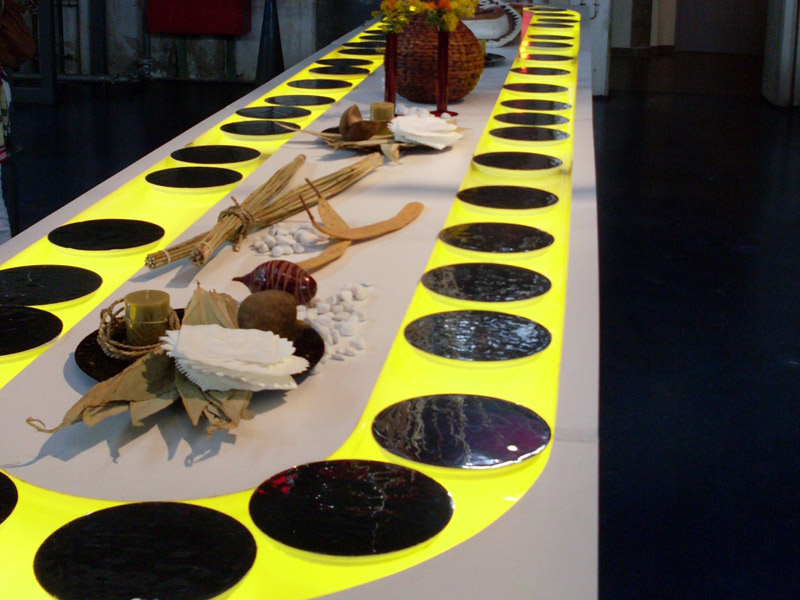
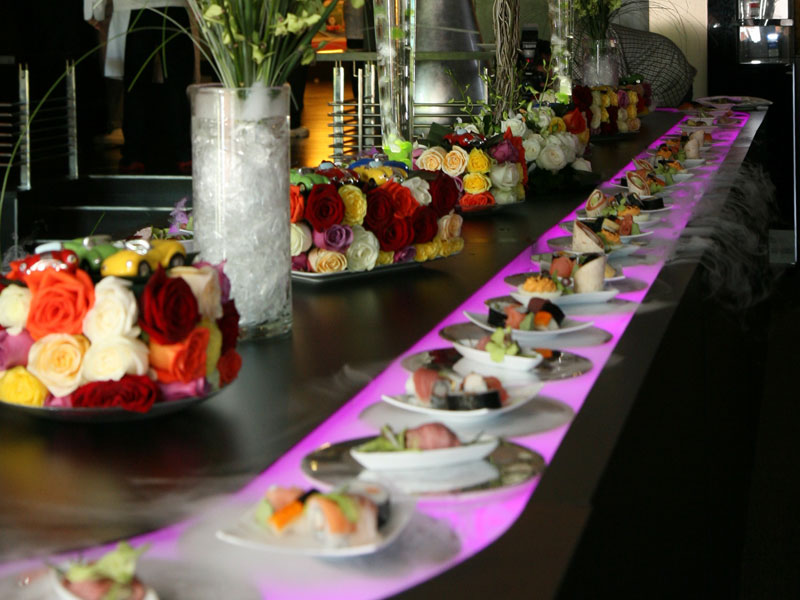
THE FLOATING BUFFET CONCEPT:


Concept of a Floating Buffet


  • Floating Buffet® is representing “A Revolutionary Movement in Catering Industry”.
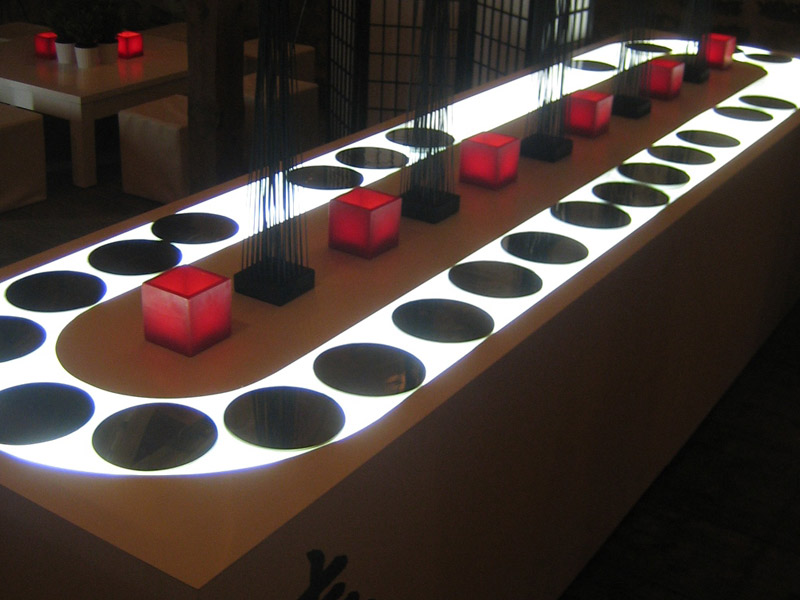
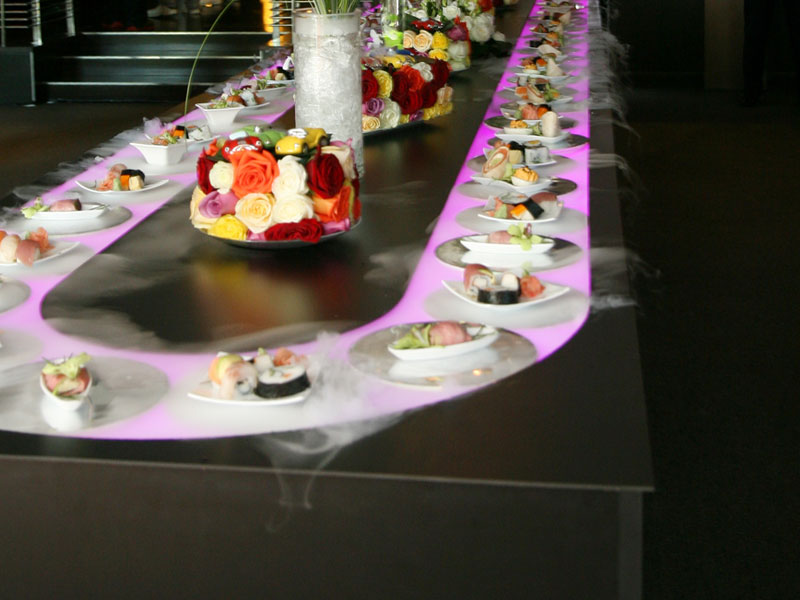
  • The food items aren’t displayed on the conventional static way as on a traditional buffet. Instead it is presented using continuously moving water way on a mobile Floating buffet®.
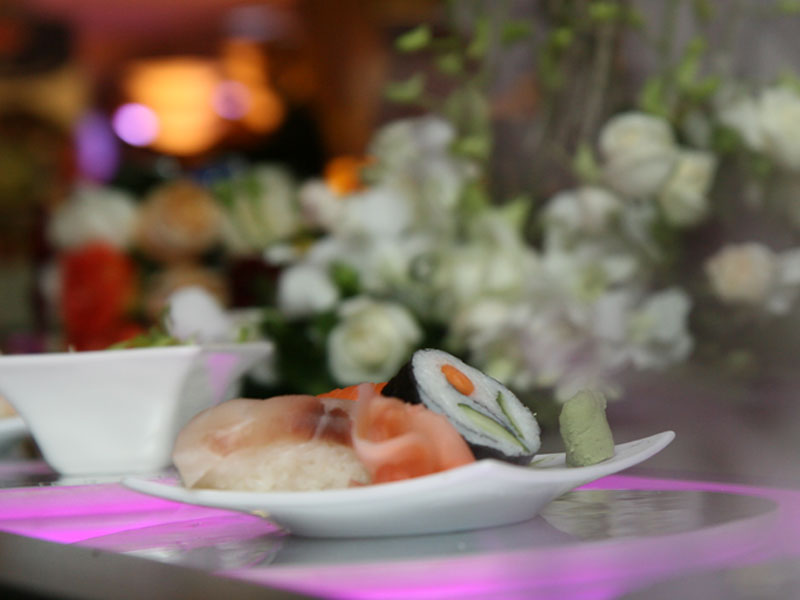
  • The water way is lighted from beneath. Color can be changed according to your party needs.
  • The specially designed food items are individually plated and presented to your guests on floating plates.
  • This new Catering Concept is representing a new area in the catering industry.
  • Inspire yourselves from the innovative advantages what the Floating Buffet® can offer.
  • Redefine the Meaning of VIP Cocktail Service
  • This innovative buffet is giving you a competitive edge to be different then your competitors on the market!
  • Contact us for more details and be a part of the latest trend setting revolution in the Catering Industry.


Contact details:


International sales

office@floatingbuffet.com

Telephone: +40 758 103 900


Rental & Catering Services

catering@floatingbuffet.com

Telephone: +40 744 836 444


www.floatingbuffet.com


As usual I will await for your valuable feedback.

Until the next issue.

Don't forget to visit Chef. Gianfranco Chiarini's web page @: http://www.executivechefgianfrancochiarini.com/

And if you are not a fan of his culinary page; click on:

http://tinyurl.com/brc9vz

With our warmest culinary regards.

Anna Chiarini. 

Dienstag, 21. September 2010

How to make a refreshing, ITALIAN MOJITO.

Mojito is my favorite cocktail. Rum, mint, lime, and sugar combine to make an incredibly delicious and thirst-quenching drink.

According to the legend told by the late Angel Martinez, the origins of the Mojito derive from a drink made of sugar cane-sweetened water spiked with unrefined rum that was consumed by slaves in Cuba in the late 19th century.

By the early 20th century, the story goes, the Mojito came into its own in Cuba as a popular drink at the Playa de Marianao, a working-class beach in a borough of Havana.

International acclaim for the cocktail emerged after 1946, the year that Mr. Martinez opened La Bodeguita del Medio in Havana and started to serve Mojitos endorsed by Ernest Hemingway, attracting the likes of Brigitte Bardot, Pablo Neruda, Nat King Cole, and Errol Flynn, among others.

Today, La Bodeguita is a major tourist destination (tourist trap, according to this article), has even spawned a copycat in Palo Alto, California.

I like to make my Italian Mojito by muddling a substantial amount of Basil leaves (5 to 10, depending on their size, though I don't think I've ever used too much Basil leaves and Lemongrass) with two teaspoons of sugar (a mortar and pestle will also work for this step).

The important thing is to grind the sugar into Basil leaves and Lemongrass so that the granules are completely incorporated and dissolved within the Basil and Lemongrass and its juices. This will form a sort of paste of Basil, Lemongrass and sugar. Combine with the juice of one lime and the leftover lime, cut into quarters. Add two ounces of white rum.

I like to use Marti Autentico Licor de Ron, Cuban-style white rum that is flavored with lime and mint, that’s why I made the twist without the mint leaves as they are already added here in the liquor. I add San Pellegrino water instead of the Club Soda, crushed ice, and shake in a cocktail shaker.

Garnish with a sprig of lime, Basil and Lemongrass or even Mint.

Now without further due, let’s make this Mojito twist my way and let’s drink responsible ok?

For the simple syrup...

2 cups water
1 1/2 cups sugar
1/4 cup chopped Basil leaves, loosely packed
1/4 cup lemon grass, chopped, outer stalks removed first

For the cocktail...

1 Liter Marti Autentico Licor de Ron, Cuban-style, chilled (in absence of Marti Autentico Licor de Ron, Cuban-style you can use Grey Goose)

1 bottle Pellegrino mineral water or seltzer or club soda, chilled herb-infused simple syrup from above.

1 lime, cut into quarter wedges, then cut in half again (or 1 lemon, cut similarly)

1 bunch, approximately half cup, clean Basil leaves, coarsely chopped (leave some whole if you want to add some drama to the glass!)

Crushed ice

For the garnish

Lime wedges, inner stalk of lemon grass as a swizzle, Basil leaves left whole or mint like I said before.

1. To make the herb-infused syrup place the sugar and herbs in a mortar and mix the sugar with the juices, let it rest. Then add the whole after 15 minutes to the water in a pot over medium heat, stir till sugar dissolves. Bring to a boil. Stir in the Basil leaves, and lemon grass.

Bring back to a boil and cook for approximately a minute. Turn heat down to simmer, and allow herbs to infuse the syrup for approximately twenty minutes. Turn off heat, and allow steeping for at least an hour. Taste. If the syrup doesn't taste properly infused, then bring back to a boil, and repeat.

Be careful not to over boil as the syrup will turn bitter. Set aside and allow cooling.

2. In bottom of a rocks glass place coarsely chopped Basil leaves. Put lime (or lemon) wedges on top of leaves and pour in one jigger (approximately two ounces) of the simple syrup. Using a wooden spoon, the palm end of a hand-held citrus juicer, or even the bottom of a small shot glass; mash the lime and leaves so that the oils and juice are released from both. You should have a nice pulpy mess in the bottom of the glass when you're finished.

3. Add to the glass one jigger of mineral water or soda water. Add a few pieces of crushed ice. Stir.

4. Top with one jigger of Marti Autentico Licor de Ron, Cuban-style or the replacement killer I suggested. Stir well. Garnish with lime (or lemon,) a thin stalk of lemon grass as a swizzle, and a few whole leaves of the Basil leaves. Enjoy!

NOTES: While I used mineral water, I think seltzer or club soda might have actually been better as their higher sodium content would have mixed well with the peppery nature of the Basil leaves and the slight sting of the lemon grass in the simple syrup. Either way, the effervescence gave nice buoyancy to all of the ingredients. Of course I wanted to make it Italian.

I called this an Italian Mojito because of the similarities in their means of preparation, not because of similarities in ingredients.


With our warmest culinary regards.

Don't forget to visit our page: @:http://www.executivechefgianfrancochiarini.com/

And if you are not a fan of our culinary page; click on:

http://tinyurl.com/brc9vz

Samstag, 18. September 2010

FOR CHEFS AND CULINARY PROFESSIONALS ONLY:

THE BIGGEST CULINARY DATA-BASE IN THE GLOBE:

Dear, Chefs and Culinary Professionals.

First of all thank you for having joined the culinary page of our awarded chef, Gianfranco Chiarini. Your presence there is highly appreciated.

The reason for this communication today is to inform you all that Chef. Gianfranco has created the biggest Culinary Data-Base on the web.

This data-base will be used to help you find new opportunities in the market, new contacts, networking solutions and culinary problem solving around the world.

When you need a culinary connection with a particular continent this data base will connect you with the Chef or the Chefs whom can clear your culinary doubts.

The data base as we said will be divided by continents and there will be a Culinary Director per Continent, and sub directions per country.

The success of this data base counts on your cooperation as we need you all to join in order to help it grow. All we need from you is to fill a small form that will go directly into a global data base.

Please click her: https://spreadsheets.google.com/viewform?formkey=dFJhUmM1QnhkaGxpUjNXdk9OYkMySFE6M

and you'll be re-directed immediately into our data filler.

Thank you all for your cooperation, and we are looking forward to the success of this project and the development of this very important tool that will help us all for the first time on a global scale. Be a part of something big.

Remember to spread the voice into this huge globe project.

With our warmest culinary regards.

Don't forget to visit our page: @:http://www.executivechefgianfrancochiarini.com/

And if you are not a fan of our culinary page; click on:http://tinyurl.com/brc9vz

Freitag, 17. September 2010

How to make a delicious Pear & Caramel Ice cream.

PEAR CARAMEL ICE CREAM.

RECIPE.

1 C. sugar
1 1/2 C. heavy whipping cream
2 large very ripe pears, peeled and thinly sliced
1/2 C. sugar
1/2 C. milk
1 vanilla bean, scraped

PREPARATION.

Begin by making the caramel. Put 1 cup of sugar in a heavy saucepan over very low heat. Swirl it around every minute or so until it turns light brown. Begin stirring as the sugar starts liquefying. Once the lumps are gone, stir vigorously (do not leave it or it will boil over and burn!) for another two minutes. The color should be a rich brown.

Remove the pan from the heat and carefully add 1/3 cup of warm water. The caramel will sputter and steam as it hardens. Return the pan to very low heat, stirring constantly, until caramel is liquid again. Add the pears to the pan and stir constantly, cooking until soft, about 3-4 minutes.

Take off the stove and use a slotted spoon to remove the pears, allowing the caramel to drip back off into the pan. Puree the pears in a food processor or blender until relatively smooth. Set aside.

Put the half-cup of sugar, cream, milk and vanilla scrapings/pod in a medium saucepan and heat over medium until sugar is dissolved and the mixture is warm. Fish out the vanilla pod and discard. Using an electric mixer, whip the cream mixture for several minutes until the mixture thickens and you notice an increase in volume.

Fold in the pureed pears and half of the slightly cooled caramel. Pour the mixture into your ice cream machine and freeze according to manufacturer’s directions. Just before removing the ice cream from the machine, drizzle in the remaining caramel and allow it to mix in slightly for about 30 seconds.

Put ice cream in an airtight container and place in your refrigerator freezer until firm. And Buon Appetito!


Don't forget to visit my favorite Chef's web page @: http://www.executivechefgianfrancochiarini.com/

And if you are not a fan of his culinary page go ahead and do it now; click on: http://tinyurl.com/brc9vz